Institute for Marriage and Public Policy
“Strengthening marriage for a new generation”
Enter Marriage Debate Blog
From President: Maggie Gallagher is President of the Institute for Marriage and Public Policy and a co-author of The Case for Marriage.
“If Marriage is Natural, Why Is Defending It So Hard?”Ave Maria Law Review 2006
SSM and the Fate of Religious Liberty: Heritage Debate, May 22, 2006
Gay Marriage: Evidence from Europe?
June 1 Cato debate between Maggie Gallagher and William Eskridge
Jon Rauch and Maggie Gallagher at University of Calif. San Diego
(How) Will Gay Marriage Weaken Marriage as a Social Institution: A Reply to Andrew Koppelman University of St. Thomas Law Journal, Fall 2005, Volume 2 Number 1
| NEW FROM IMAPP | |
|
DOES DIVORCE LAW AFFECT THE DIVORCE RATE? A REVIEW OF EMPIRICAL RESEARCH Executive Summary: Did the introduction of no-divorce law affect the divorce rate? This study looks at all the empirical research since 1995 that examines the impact of no-fault divorce laws on divorce rates both in the United States and in other nations, 24 studies in all, and concludes:
The idea that family law has no independent effect on family behaviours is difficult to reconcile with either economic theory or existing empirical research. Family scholars, policymakers, legislators, and media need to consider and take seriously the complex ways in which family law affects the likelihood that couples and children will enjoy the benefits of stable marriage. Prenuptial Agreement FormsOne of the way to make a marriage stable is a Prenuptial Agreement. Someone will say that it’s not a good way to express feelings. However, divorces are often caused by financial disagreements. Prenuptial agreements, or simply prenups, can manage these issues and help a couple avoid misunderstandings in the future. You can consider a prenup as a business partnership agreement between romantic partners. A prenuptial agreement can be signed in advance, say two months before the wedding or right before the ceremony. If you decide to sign such an agreement after the wedding, it will be a postnuptial agreement. In Florida, soon-to-be-marry couples can use Prenuptial Agreements Florida to outline how the marital property and assets would be divided in case of a divorce. Florida is not a community property state, so the marital property is usually divided equitably between ex-spouses. But there can be some drawbacks, even in the equitable division. First of all, a judge decides what division is equitable, which may not always correlate with the spouses’ opinion. Secondly, each spouse may be awarded a percentage of the total value of the assets that can also be a bit confusing. So, a prenup is advantageous even in a non-community property state. Texas is a community property state, which means that all the property acquired during the marriage will be divided equally (50/50) in the case of divorce. Prenuptial Agreements Texas are designed for couples who want to manage the property and financial issues by themselves. Prenups allow partners to control the property division and alimony designation in the event of a divorce or death. Additionally, the agreement can come in handy when you want to determine the property management during the marriage. Like Texas, California law provides an equal division of the marital property in the event of a divorce. It doesn’t matter whether this or that asset is in one spouse’s name. Community property law can even affect the assets acquired before the marriage. As a rule, these assets are considered as separate property, but any improvements or changes to the property during the marriage can make it community. Here, a Prenuptial Agreement California should come into play. The agreement will help a couple to set their own rules related to the assets management and division. If you live in New York, you may use Prenuptial Agreements NY. The agreement will serve as an effective tool to set control over the marriage’s financial part. While someone considers a prenup to be bad luck, the agreement can provide peace of mind for both spouses regarding personal money and debts. In New York, prenuptial agreements secure each spouse’s rights to the property, alimony, and in a family business (if any). A prenup can also take care of your children from a previous marriage, securing the inheritance in the event of death. Prenuptial Agreement Forms by StatePrenuptial agreements are mainly subject to the Uniform Premarital Agreement Act (UPAA/UPMAA). It’s a multi-state law that outlines how prenuptial agreements should be enforced and what terms they can cover. The UPAA/UPMAA has been adopted by 28 states and the District of Columbia. Other 22 states still recognize prenuptial agreements as legally binding, but they have their laws related to this matter. Some requirements apply in every state—a prenup must be signed voluntarily by both parties in the presence of a notary public. Additionally, the agreement cannot cover child custody and child support issues. However, other requirements can vary depending on whether it’s a community or a separate property state. Community property states are Arizona, California, Idaho, Louisiana, Nevada, New Mexico, Texas, Washington, and Wisconsin. The following list will help you prepare your state-specific document.
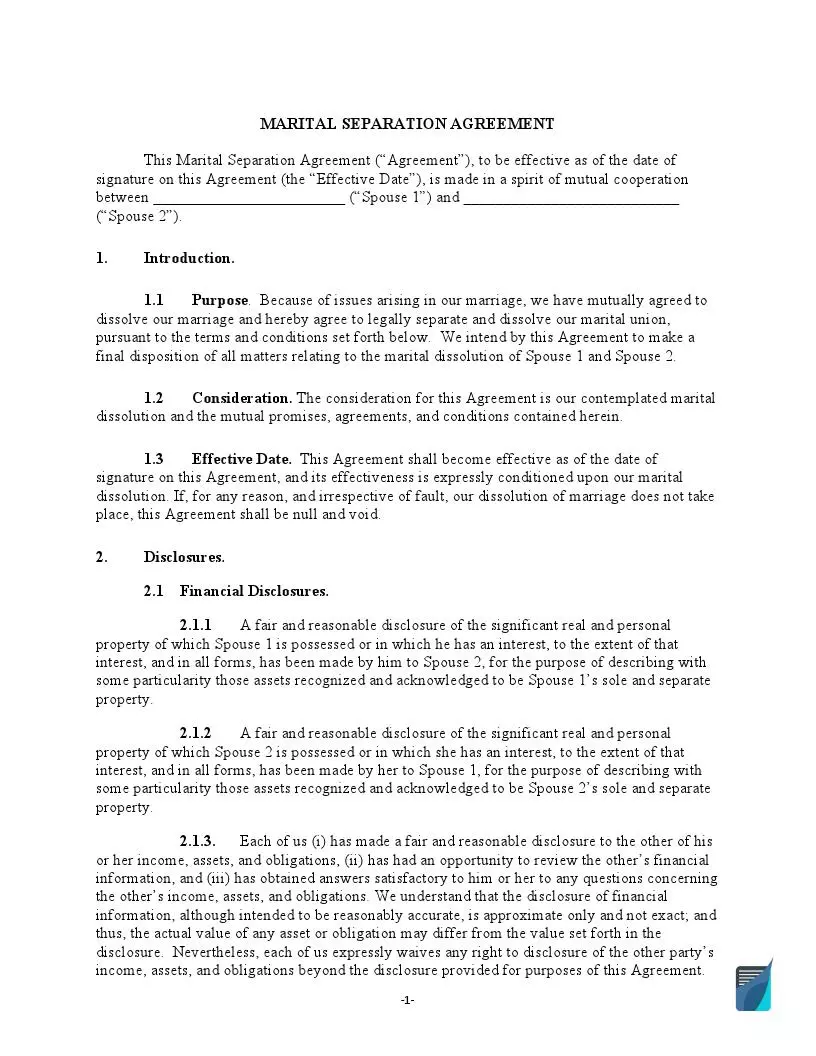
Divorce (Marital) Settlement Agreement FormsSometimes, it may seem hard for a married couple to reach an agreement. And often, the only way out they see is to divorce. But it’s not always the best solution. In some cases, they just need to live separate for a while, and a Marriage Separation Agreement can help them manage a separation period. It’s essential to know that separation is not a divorce. With a marriage separation agreement, a couple remains legally married but stops living together. The agreement is needed to control specific financial issues, child custody and visiting hours, and debts. We see separation as a way for a couple to reconcile in the future and save the marriage. However, the separation period can also be used as a preparation stage before divorcing. Alternatively, a couple may agree on a permanent separation due to their religious beliefs or social benefits. We strive for a healthy and stable marriage, but if things just won’t work out, and a couple doesn’t see another way but to divorce, everything should be civilized. That’s why it’s recommended to prepare a Marital Settlement Agreement, also known as a Divorce Settlement Agreement. A divorce settlement agreement means an inevitable dissolution of marriage. It includes more or less the same information as a prenuptial agreement or a marriage dissolution agreement—division of the marital property, assets, debts, alimony designation, and spousal support. However, unlike a marriage separation agreement, a marital settlement agreement should be granted in the form of a court order. In Virginia, a divorcing couple may use a Virginia Marital Settlement Agreement to set the property, assets, and debts division as they wish. With the agreement, they can also outline child custody preferences, alimony, and spousal support. A divorce settlement agreement helps to reduce the obligatory separation period for spouses without minor children. However, a court may always deem some of the agreement’s provisions unfair and change the terms. If you live in North Carolina, you will have to live separately from your spouse for one year before filing for divorce. During this period, you can prepare a Marital Settlement Agreement North Carolina that will help you arrange some of the essential divorce proceedings, like assets and debts division, spousal support and alimony, as well as child custody and support. In North Carolina, the court uses particular child support guidelines to manage the matter. But if the spouses provide fair and reasonable child support terms in their agreement, the court may use them as the basis. A Marital Settlement Agreement California is designed for California residents who are going to get divorced. California is a community property state meaning that the marital property will be divided equally in the event of a divorce. A divorce settlement agreement can arrange these matters differently. A couple may use the agreement to determine not only the property and assets division but also alimony and spousal support arrangements. The soon-to-be-ex partners can also outline how they see child custody and parenting visiting hours, but the court may not recognize these provisions and will act in the best child’s interest. Divorce (Marital) Settlement Agreements by StateSimilar to prenuptial agreements, marital settlement agreements are subject to state laws. First of all, this involves obligatory divorce waiting periods different in all states. Secondly, there are specific state laws regarding alimony and child support arrangements, as well as grounds for “no-fault” divorce and residency requirements. Additionally, you may need to consider whether the state is community property. As you can see, choosing a state-specific template is a vital part of the agreement preparation. That’s why we gathered them below.
Sample Divorce (Marital) Settlement Agreement:
WHAT DO AMERICANS THINK ABOUT MARRIAGE? A new Pew poll was released this week to great fanfare. One key finding: Americans have a problem with unmarried childbearing. The Pew poll asked this question in a variety of ways: Seventy-one percent of Americans say the growth in births to unwed mothers is a “big problem” for society, while 69 percent agree “A child needs a home with both a mother and father to grow up happily.” By a margin of 66 percent to 25 percent, Americans say that “single women having children” is a trend that is “bad for society,” rather than “good.” The breadth of this consensus across lines of age, race and education is striking: Seventy percent of whites and 67 percents of black agree it’s a bad trend for society (as do 54 percent of Hispanics). Seventy-two percent of senior citizens say it’s a bad thing, but so do 65 percent of 18 to 29-year-olds. Sixty-eight percent of college grads worry about unmarried childbearing, but so do 65 percent of Americans with only a high school degree or less. . . HUMAN RIGHTS CAMPAIGN: DEMS SUPPORT OVERTURNING DOMA “This groundbreaking and unified position of all Democratic candidates would override Section 3 of the so-called “Defense of Marriage Act,” which provides that for federal purposes, “The word ‘marriage’ means only a legal union between one man and one woman as husband and wife, and the word ‘spouse’ refers only to a person of the opposite sex who is a husband or a wife.” . . . full press release here. THE GOP DEBATE: WHERE’S MARRIAGE? Kay Hymowitz and Brad Wilcox ask in the June 5, 2007 National Review Online: “Here we are at debate #3, but has anyone heard a Republican besides Mitt Romney utter their one-time favorite word ‘family?’ In fact, most of the top Republican presidential nominees are studiously avoiding the biggest social problem of our time, namely, family breakdown. . .” full article here DEFINING MARRIAGE DOWN “Does permitting same-sex marriage weaken marriage as a social institution? Or does extending to gay and lesbian couples the right to marry have little or no effect on marriage overall? Scholars and commentators have expended much effort trying in vain to wring proof of causation from the data–all the while ignoring the meaning of some simple correlations that the numbers do indubitably show. . .” More here. Excerpted from David Blankenhorn’s new book “The Future of Marriage” copy here. GAY MARRIAGE RIPE FOR DECISION IN 3 COURTS “Three years after its historic court ruling legalizing same-sex marriage, Massachusetts stands alone in blessing gay marriages — 6,500 to date — and its example has spurred no imitators but lots of backlash. Following the festive scenes of gay and lesbian brides and grooms waiting in long lines to wed in the Bay State on May 17, 2004, 23 states — for a total of 27 — fortified their state constitutions to withstand judicial edicts like the Massachusetts one. Massachusetts itself is considering a proposal to end its experiment with same-sex unions. . . . All eyes now are on the highest courts in California, Connecticut and Maryland, where decisions on the constitutionality of gay marriage are likely this year . . . ” STATE MARRIAGE AMENDMENTS WIN IN 7 OF 8 STATES. THE CASE FOR STRENGTHENING MARRIAGE: Georgia Chief Justice Leah Sears in the Oct. 30 Washington Post: “Americans believe that problems, no matter how difficult, should be addressed and not merely endured. Whether it is racism, crime or poverty, Americans believe that we can find ways to make a difference. Accepting the decline of marriage as inevitable means giving up on far too many of our children. They deserve better than that.” Full article here. On September 14, iMAPP releases: “Marriage and the Law: A Statement of Principles,” signed by over 100 legal and family scholars. The statement asks: “What if marriage really is an essential core institution of American society, a close kin in importance to private property, free speech and free enterprise, public education, equal protection of the law, and a democratic form of government? How then should law and society treat marriage?” The family diversity model, these scholars argue have failed: “A major goal of marriage and family law should be supporting civil society’s efforts to strengthen marriage, so that more children are raised by their own married mother and father in loving, lasting unions.” To Download a copy click here CALIFORNIA APPEALS COURT UPHOLDS MARRIAGE 2-1. “Courts simply do not have the authority to create new rights, especially when doing so involves changing the definition of so fundamental an institution as marriage.” Copy of decision click here. The Revolution in Parenthood: The Emerging Global Clash Between Adult Rights and Children’s Needs An international appeal from the Commission on Parenthood’s Future. Elizabeth Marquardt, Principal Investigator. To Download a copy click here WASHINGTON STATE SUPREME COURT UPHOLDS MARRIAGE Decision here.. FEDERAL COURT RULES FOR NEBRASKA MARRIAGE AMENDMENT You can access today’s ruling of the U.S. Court of Appeals for the Eighth Circuit here. The federal district court’s ruling, which the Eighth Circuit reversed today, can be accessed at this link. CONNECTICUT TRIAL COURT JUDGE RULES AGAINST SSM The judge’s opinion is here. NY HIGHEST COURT UPHOLDS MARRIAGE 4-2 “We conclude, however, that there are at least two grounds that rationally support the limitation on marriage that the Legislature has enacted. . . . First, the Legislature could rationally decide that, for the welfare of children, it is more important to promote stability, and to avoid instability, in opposite-sex than in same-sex relationships. Heterosexual intercourse has a natural tendency to lead to the birth of children; homosexual intercourse does not. Despite the advances of science, it remains true that the vast majority of children are born as a result of a sexual relationship between a man and a woman, and the Legislature could find that this will continue to be true. The Legislature could also find that such relationships are all too often casual or temporary. It could find that an important function of marriage is to create more stability and permanence in the relationships that cause children to be born. It thus could choose to offer an inducement — in the form of marriage and its attendant benefits — to opposite-sex couples who make a solemn, long-term commitment to each other. The Legislature could find that this rationale for marriage does not apply with comparable force to same-sex couples. These couples can become parents by adoption, or by artificial insemination or other technological marvels, but they do not become parents as a result of accident or impulse. . . This is one reason why the Legislature could rationally offer the benefits of marriage to opposite-sex couples only. There is a second reason: The Legislature could rationally believe that it is better, other things being equal, for children to grow up with both a mother and a father. Intuition and experience suggest that a child benefits from having before his or her eyes, every day, living models of what both a man and a woman are like. It is obvious that there are exceptions to this general rule — some children who never know their fathers, or their mothers, do far better than some who grow up with parents of both sexes — but the Legislature could find that the general rule will usually hold. Plaintiffs, and amici supporting them, argue that the proposition asserted is simply untrue: that a home with two parents of different sexes has no advantage, from the point of view of raising children, over a home with two parents of the same sex. Perhaps they are right, but the Legislature could rationally think otherwise. To support their argument, plaintiffs and amici supporting them refer to social science literature reporting studies of same-sex parents and their children. Some opponents of same-sex marriage criticize these studies, but we need not consider the criticism, for the studies on their face do not establish beyond doubt that children fare equally well in same- sex and opposite-sex households. What they show, at most, is that rather limited observation has detected no marked differences. More definitive results could hardly be expected, for until recently few children have been raised in same-sex households, and there has not been enough time to study the long- term results of such child-rearing. Plaintiffs seem to assume that they have demonstrated the irrationality of the view that opposite-sex marriages offer advantages to children by showing there is no scientific evidence to support it. Even assuming no such evidence exists, this reasoning is flawed. In the absence of conclusive scientific evidence, the Legislature could rationally proceed on the common- sense premise that children will do best with a mother and father in the home. (See Goodridge, 798 NE2d at 979-980 [Sosman, J., dissenting].) And a legislature proceeding on that premise could rationally decide to offer a special inducement, the legal recognition of marriage, to encourage the formation of opposite- sex households. . .” SCHOLARS RELEASE “PRINCETON PRINCIPLES ON MARRIAGE” In recent years, marriage has weakened, with serious negative consequences for society as a whole. Four developments are especially troubling: divorce, illegitimacy, cohabitation, and same-sex marriage. The purpose of this document is to make a substantial new contribution to the public debate over marriage. Too often, the rational case for marriage is not made at all or not made very well. As scholars, we are persuaded that the case for marriage can be made and won at the level of reason. Marriage protects children, men and women, and the common good. The health of marriage is particularly important in a free society, which depends upon citizens to govern their private lives and rear their children responsibly, so as to limit the scope, size, and power of the state. The nation’s retreat from marriage has been particularly consequential for our society’s most vulnerable communities: minorities and the poor pay a disproportionately heavy price when marriage declines in their communities. Marriage also offers men and women as spouses a good they can have in no other way: a mutual and complete giving of the self. Thus, marriage understood as the enduring union of husband and wife is both a good in itself and also advances the public interest. . . . full document here GAY MARRIAGE LOOMS AS ‘BATTLE OF OUR TIMES’ The battle over same-sex marriage is shaping into something more than deep societal tradition vs. civil rights. It is becoming a conflict of equality vs. religious liberty. As gays make gains, some religious institutions are coming under pressure.. . .While no one expects the courts to force unwilling clergy to perform weddings for same-sex couples, some see a possibility that religious groups (other than houses of worship) could lose their tax-exempt status for not conforming to public policy, as did fundamentalist Bob Jones University, over racial issues in 1983. . . . . Full Story here BANNED IN BOSTON: “Just how serious are the coming conflicts over religious liberty stemming from gay marriage? “The impact will be severe and pervasive,” Picarello says flatly. “This is going to affect every aspect of church-state relations.” Recent years, he predicts, will be looked back on as a time of relative peace between church and state, one where people had the luxury of litigating cases about things like the Ten Commandments in courthouses. In times of relative peace, says Picarello, people don’t even notice that “the church is surrounded on all sides by the state; that church and state butt up against each other. The boundaries are usually peaceful, so it’s easy sometimes to forget they are there. But because marriage affects just about every area of the law, gay marriage is going to create a point of conflict at every point around the perimeter.. . ” Full Story here STUDY ASSESSES HOW MANY GAYS MARRY IF LEGAL NEW YORK (AP) — A new study attempts to gauge the percentage of gays and lesbians who have chosen to marry in places where that option is legal, with estimates ranging from as little as 2 percent to more than 16 percent, depending on the location. A co-author of the report, released Wednesday, said both sides in the gay marriage debate may take heart from the findings. The Institute for Marriage and Public Policy, which opposes gay marriage, reviewed data from the Netherlands, Belgium, Canada and Massachusetts, all of which allow same-sex partners to wed. In each case, the study offered a range of estimates of the percentage of gays who had married, based on varying approximations – from 1 percent to 5 percent – of how many gays were in the general population. In the Netherlands, where 8,127 same-sex couples married from April 1, 2001, through last December, the study said this represented between 2.6 percent and 6.3 percent of the country’s gays and lesbians. The study estimated that between 2 percent and 5 percent of Belgium’s gays and lesbians, and 5.9 percent to 16.7 percent of those in Massachusetts had married. Same-sex marriage became legal in Massachusetts in May 2004, and 7,341 gay and lesbians couples had wed there through last December. . .” Rest of story. NEW RELIGIOUS COALITION FOR MARRIAGE “About 50 prominent religious leaders, including seven Roman Catholic cardinals and about a half-dozen archbishops, have signed a petition in support of a constitutional amendment blocking same-sex marriage. Organizers of the petition said it was in part an effort to revive the groundswell of opposition to same-sex marriage that helped bring many conservative voters to the polls in some pivotal states in 2004. The signers include many influential evangelical Protestants, a few rabbis and an official of the Church of Jesus Christ of Latter-day Saints. But both the organizers and gay rights groups said what was striking about the petition was the direct involvement by high-ranking Roman Catholic officials, including 16 bishops. Although the church has long opposed same-sex unions, and the United States Conference of Catholic Bishops had previously endorsed the idea of a constitutional amendment banning such unions, it was evangelical Protestants who generally led the charge when the amendment was debated in 2004. “The personal involvement of bishops and cardinals is significantly greater this time than in 2004,” said Patrick Korten, a spokesman for the Knights of Columbus, a lay Catholic group. The Catholic bishops and many of the other religious leaders involved have pledged to distribute postcards for their congregants to send to their senators urging support for the amendment. The Knights of Columbus is distributing 10 million postcards to Catholic churches. The petition drive was organized in part by Prof. Robert P. George of Princeton, a Catholic scholar with close ties to evangelical Protestant groups. Aides to three Republican senators — Bill Frist of Tennessee, the Republican leader; Rick Santorum of Pennsylvania; and Sam Brownback of Kansas — were also involved, organizers said. Archbishop John J. Myers of Newark said that at a meeting in Washington in February, the Senate aides recommended the idea of a postcard campaign, recalling the success of a similar effort that the bishops organized in support of a ban on so-called partial-birth abortion. “We think the American people are on our side on this, and we want the Senate to know it,” the archbishop said. . .” Rest of the story here: http://www.nytimes.com/2006/04/24/washington/24catholic.html SENATE MAJORITY SUPPORTS MARRIAGE PROTECTION AMENDMENT A majority of the Senate this year will support the Federal Marriage Amendment, an outcome that both the left and the right say will energize their respective bases in November. In the summer of 2004, the effort to define marriage as between a man and a woman failed in the Senate, on a 48-50 vote. Now that Republicans have increased their majority, the amendment has collected more support. If all senators vote the way they did in 2004 and the freshmen vote as expected, the bill will attract 52 votes — well short of the 67 needed to amend the Constitution. First-term Sens. Jim DeMint (R-S.C.), Mel Martinez (R-Fla.), John Thune (R-S.D.) and David Vitter (R-La.) have all co-sponsored the amendment. These four legislators replaced Democrats who voted against the amendment in 2004. http://thehill.com/thehill/export/TheHill/News/Campaign/041206.html MASS BAN ON CATHOLIC CHARITIES ADOPTION: “THIS IS A TRAGEDY FOR KIDS.” “For two decades, Catholic Charities has occupied a small but crucial niche in the state’s sprawling social safety net: helping to find homes for the most troubled foster children, including those with HIV and AIDS, mental and emotional problems, and histories of abuse. The Boston agency’s decision yesterday to abandon that service will eliminate that critical link between thousands of foster children and the families looking to adopt them. Adoption specialists say the risks for children are real: Foster children could face longer waits in an already backlogged system, and specialists say other agencies will have to scramble to pick up the Catholic Charities’ caseload. Whether they can replace its network of seasoned, caring social workers is another question. “Catholic Charities has really been a gold standard in providing adoption services to children in the welfare system for a long time, so this is a tragedy,” said Marylou Sudders, president of the Massachusetts Society for the Prevention of Cruelty to Children. “This is a tragedy for kids. . . ” Full Story Here. DUTCH “TRENDS IN COHABITING AND MARRIAGE” A study on Dutch trends in marriage, including out of wedlock births, (mentioned by Stanley Kurtz in a recent NRO piece). We provide a link to the original article and to an English translation for interested scholars, readers, and policymakers on both sides of the marriage debate. NY APPELLATE COURTS RULES 5-0 FOR MARRIAGE “Plaintiffs seek to bring the right to marry the person of their choosing regardless of gender within the protection of the well-recognized fundamental right to marry. However, we find merit in defendants’ assertion that this case is not simply about the right to marry the persons of one’s choice, but represents a significant expansion into new territory which is, in reality, a redefinition of marriage. The cornerstone cases acknowledging marriage as a fundamental right are laced with language referring to the ancient recognized nature of that institution, specifically tying part of its critical importance to its role in procreation and thus, to the union of a man and a woman. . . . It is an undisputed biological fact that the vast majority of procreation still occurs as a result of sexual intercourse between a male and a female. In light of such fact, “[t]he State could reasonably decide that by encouraging opposite-sex couples to marry, thereby assuming legal and financial obligations, the children born from such relationships will have better opportunities to be nurtured and raised by two parents within long-term, committed relationships, which society has traditionally viewed as advantageous for children” (Standhardt v. Superior Court of Arizona at 287-288).” DISSOLVING MARRIAGE: “The way to abolish marriage, without seeming to abolish it, is to redefine the institution out of existence. If everything can be marriage, pretty soon nothing will be marriage. Legalize gay marriage, followed by multi-partner marriage, and pretty soon the whole idea of marriage will be meaningless. At that point, Canada can move to what Bailey and her friends really want: an infinitely flexible relationship system that validates any conceivable family arrangement, regardless of the number or gender of partners. . .” MARRIAGE WIN IN NEW YORK COURT “Marriage, defined as the union between one man and one woman, is based upon important public policy considerations and has been recognized as a fundamental constitutional right. Marriage promotes sharing of resources between men, women and the children that they procreate; provides a basis for the legal and factual assumption that a man is the father of his wife’s child via the legal presumption of paternity plus the marital expectations of monogamy and fidelity; and creates and develops a relationship between parents and child based on real, everyday ties. It is based on the presumption that the optimal situation for child rearing is having both biological parents present in a committed, socially esteemed relationship (Reno v Flores, 507 US 292, 310 [1993] [marriage allows the state to express a preference for biological parents “whom our society . . . (has) always presumed to be the preferred and primary custodians of their minor children”]). The law assumes that a marriage will produce children and affords benefits based on that assumption. It sets up heterosexual marriage as the cultural, social and legal ideal in an effort to discourage unmarried childbearing and to encourage sufficient marital childbearing to sustain the population and society; the entire society, even those who do not marry, depend on a healthy marriage culture for this latter, critical, but presently undervalued, benefit. Marriage laws are not primarily about adult needs for official recognition and support, but about the well-being of children and society, and such preference constitutes a rational policy decision. Thus, society and government have reasonable, important interests in encouraging heterosexual couples to accept the recognition and regulation of marriage. Can Married Parents Reduce Crime? (How) Will Gay Marriage Weaken Marriage as a Social Institution: A Reply to Andrew Koppelman New Report: The Close Relationship Model A “close relationships” culture fails to acknowledge fundamental facts of human life: the fact of sexual difference; the enormous tide of heterosexual desire in human life; the procreativity of male-female bonding; the unique social ecology of parenting which offers children bonds with their biological parents; and the rich genealogical nature of family ties and the web of intergenerational supports for family members that they provide. |
|
PUBLICATION OF THE WEEK
MARRIAGE WIN IN NEW YORK COURT
Hernandez v. Robles, 2005 NY Slip Op. 09436 (NY App. Div., First Dept., Dec. 8, 2005)
“Marriage, defined as the union between one man and one woman, is based upon important public policy considerations and has been recognized as a fundamental constitutional right (Zablocki v Redhail, 434 US 374, 383 [1978]; Skinner v Oklahoma ex rel. Williamson, 316 US 535, 541 [1942]; see also Washington v Glucksberg, 521 US 702, 720 [1997]; Griswold v Connecticut, 381 US 479, 486 [1965]). These considerations are based on innate, complementary, procreative [*7]roles, a function of biology, not mere legal rights. “[T]he reasons justifying the civil marriage laws are inextricably linked to the fact that human sexual intercourse between a man and a woman frequently results in pregnancy and childbirth” (Goodridge, 440 Mass at 357 n 1, 798 NE2d at 979 n 1 [Sosman, J., dissenting]).
The legislative policy rationale is that society and government have a strong interest in fostering heterosexual marriage as the social institution that best forges a linkage between sex, procreation and child rearing. It systematically regulates heterosexual behavior, brings order to the resulting procreation and ensures a stable family structure for the rearing, education and socialization of children (Goodridge, 440 Mass at 381, 798 NE2d at 995 [Cordy, J., dissenting]). Marriage promotes sharing of resources between men, women and the children that they procreate; provides a basis for the legal and factual assumption that a man is the father of his wife’s child via the legal presumption of paternity plus the marital expectations of monogamy and fidelity; and creates and develops a relationship between parents and child based on real, everyday ties. It is based on the presumption that the optimal situation for child rearing is having both biological parents present in a committed, socially esteemed relationship (Reno v Flores, 507 US 292, 310 [1993] [marriage allows the state to express a preference for biological parents “whom our society . . . (has) always presumed to be the preferred and primary custodians of their minor children”]). The law assumes that a marriage will produce children and affords benefits based on that assumption. It sets up heterosexual marriage as the cultural, social and legal ideal in an effort to discourage unmarried childbearing and to encourage sufficient marital childbearing to sustain the population and society; the entire society, even those who do not marry, depend on a healthy marriage culture for this latter, critical, but presently undervalued, benefit. Marriage laws are not primarily about adult needs for official recognition and support, but about the well-being of children and society, and such preference constitutes a rational policy decision. Thus, society and government have reasonable, important interests in encouraging heterosexual couples to accept the recognition and regulation of marriage.
GOD’S GIFT: A CHRISTIAN VISION OF MARRIAGE AND THE BLACK FAMILY: Press release from the Seymour Institute for Advanced Christian Studies.
Not since 1965, when the late Senator Daniel Patrick Moynihan authored an historic and controversial study entitled The Negro Family: The Case for National Action, has there been an analysis of the Black Family that transcends partisan politics–so thorough, insightful, penetrating, and so complete that it resonates with every faction of the Black community. God’s Gift: A Christian Vision of Marriage and the Black Family, prepared by the Seymour Institute for Advanced Christian Studies, is that critical report. “This crisis has been long in the making, as was memorably noted by [Moynihan]. The failure of the family bodes ill for the future of the Black community given the family’s critical role in preparing the next generation for a fulfilling and productive life and for transmitting values to children that will sustain the welfare of the community.”
…”Black men and women simply don’t get married. Some Black women have a series of children, each fathered by a different man and raised in a female-headed household. High unemployment rates among Black men and their limited access to well-paying jobs have had a corrosive effect on relationships between Black couples. Another powerful contributor to the erosion of meaningful, long-term relationships between Black men and women has been a lack of sexual fidelity, especially on the part of Black men, resulting in embittered relations between Black men and women, both married and unmarried.”
…Through the release of God’s Gift, the Institute has set forth a challenge for the Black church and Black clergy to recognize this crisis and to take a strong unmistakable position on the sanctity and meaning of marriage and begin the process of teaching Black men and women to reverse self-defeating and destructive social behavioral patterns through a Christian vision for marriage and family.
DIVORCING MARRIAGE: Edited by Dan Cere and Douglas Farrow
“Is the decision the government of Canada is on the verge of taking to redefining marriage to include same-sex unions simply an act of fairness to gays and lesbians–another step in the evolution of a just society–or is it a hastily conceived social experiment that will undermine human rights, deflecting marriage from the support of children to the mere affirmation of sexual commitment between adults?
“Divorcing Marriage asks that we pause and reflect on this question and take a closer look at both the arguments for redefinition and the arguments against it; to examine the effect of redefinition on children, on the law, on freedom of speech and religion, and on society as a whole.”